

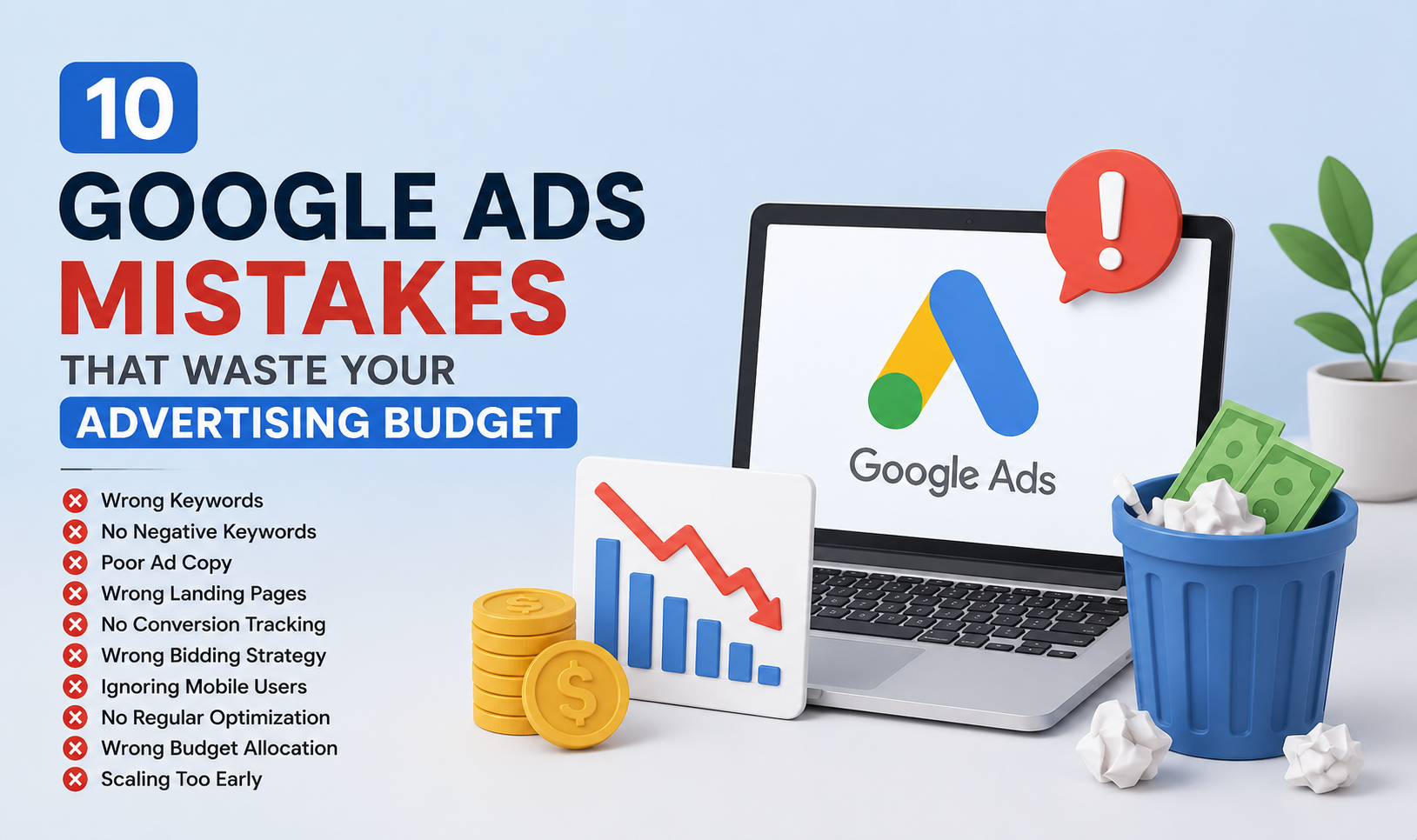
10 Google Ads Mistakes That Waste Your Advertising Budget
Running Google Ads is easy.
Running Google Ads profitably is much harder.
You can create a campaign, choose some keywords, write advertisements, set a budget, and start receiving clicks within a short period.
But clicks alone don’t mean your campaign is working.
If the wrong people are clicking, your landing page isn’t converting, your tracking is broken, or your campaign is optimized around the wrong metrics, your advertising budget can disappear without producing meaningful business results.
I’ve seen this pattern repeatedly when looking at paid advertising from a performance-marketing perspective:
Businesses don’t always have a traffic problem. They have a conversion, targeting, measurement, or strategy problem.
In this article, we’ll look at 10 common Google Ads mistakes that can waste your advertising budget and what you can do instead.
1. Targeting Broad or Irrelevant Keywords
One of the easiest ways to waste Google Ads budget is to target keywords without understanding their search intent.
Suppose you provide digital marketing services.
You might target:
digital marketing
But that search could come from someone looking for:
- A digital marketing course
- A digital marketing job
- Digital marketing salary information
- A digital marketing definition
- Free digital marketing resources
- A digital marketing agency
Not all of these people are potential customers.
Focus on commercial intent
Instead of looking only at search volume, ask:
“Does this search indicate that someone could realistically become my customer?”
Depending on your business, stronger commercial searches might include:
- Digital marketing agency
- Digital marketing services
- Google Ads agency
- PPC management services
- Performance marketing agency
- Google Ads consultant
The exact keywords will vary by business, but the principle remains the same:
Relevance and intent matter more than search volume alone.
2. Ignoring Negative Keywords
Negative keywords are one of the most useful tools for controlling irrelevant traffic.
Imagine you’re advertising paid Google Ads management.
Your keyword is:
Google Ads management
But your ads might also be triggered by searches related to:
- Google Ads course
- Google Ads jobs
- Google Ads certification
- Google Ads tutorial
- Google Ads free
These searches can generate impressions and potentially clicks without producing the type of lead you’re looking for.
Build a negative keyword strategy
Regularly review your search terms and identify searches that don’t align with your business.
Potential negative keywords might include:
- Free
- Jobs
- Salary
- Course
- Training
- Tutorial
The exact negative keyword list should be based on your actual search data rather than a generic list.
This is why regularly reviewing search terms is so important.
3. Sending Every Visitor to Your Homepage
Your homepage may be excellent for people exploring your brand.
But it isn’t necessarily the best destination for paid traffic.
Imagine your advertisement says:
“Google Ads Management for Real Estate Companies”
Then the visitor clicks and lands on a generic homepage.
They now have to figure out:
- Where is the Google Ads service?
- Do you work with real estate companies?
- What exactly do you offer?
- How much does it cost?
- Why should I contact you?
Every additional question creates friction.
Match the landing page to the advertisement
A better approach could be a dedicated landing page specifically focused on:
Google Ads Management for Real Estate Businesses
The page can then continue the same message from:
Search → Ad → Landing Page → CTA
The more consistent that journey is, the easier it becomes for the visitor to understand what you offer.
4. Writing Generic Ad Copy
Your advertisement has one important job:
Convince the right person to click.
Generic messaging makes that harder.
Compare:
Digital Marketing Services
with:
Generate More Qualified Leads With Google Ads
The second communicates a specific outcome.
Depending on your business, your ads could highlight:
- A specific problem
- A specific customer
- A specific benefit
- A specific service
- A specific offer
- A reason to choose you
Make the message relevant
If someone searches:
“Google Ads agency for dentists”
your advertisement should ideally speak to that intent.
For example:
Google Ads for Dental Clinics
Generate More Patient Enquiries
Book a Free Strategy Call
The message is immediately relevant to the search.
5. Optimizing for Clicks Instead of Business Results
This is one of the biggest mistakes in performance marketing.
A campaign can produce:
- High impressions
- High clicks
- High CTR
- Low CPC
and still be a poor campaign.
Why?
Because none of those numbers automatically mean revenue.
Imagine:
Campaign A
500 clicks
50 leads
10% conversion rate
Campaign B
1,000 clicks
20 leads
2% conversion rate
Campaign B generated twice as many clicks.
But Campaign A generated more leads.
That’s why the goal shouldn’t simply be:
“Get more clicks.”
The goal should be:
“Generate more valuable business outcomes.”
Depending on the business, those outcomes could include:
- Qualified leads
- Sales
- Bookings
- Calls
- Purchases
- Revenue
6. Running Ads Without Proper Conversion Tracking
If you don’t know which campaigns, ads, keywords, or audiences generate meaningful conversions, optimization becomes guesswork.
You may think:
“This campaign is performing well because it has lots of clicks.”
But perhaps another campaign is generating fewer clicks and more customers.
Without reliable conversion data, you can’t clearly see the difference.
Track the actions that matter
Depending on the business, important conversions could include:
- Lead form submissions
- Phone calls
- Purchases
- Bookings
- Demo requests
- Quote requests
- WhatsApp enquiries
- Sign-ups
The important point is to distinguish between activity and business value.
A click is an activity.
A qualified customer can be business value.
7. Using the Same Budget for Every Campaign
Not every campaign deserves the same budget.
Imagine you have three campaigns:
Campaign A: ₹500/day
Campaign B: ₹500/day
Campaign C: ₹500/day
That might look balanced.
But what if:
- Campaign A generates profitable customers
- Campaign B generates poor-quality leads
- Campaign C produces almost no conversions
Keeping the budget equal doesn’t make much sense.
Allocate budget based on performance
As data accumulates, look at:
- Conversion volume
- Cost per conversion
- Lead quality
- Customer acquisition cost
- Revenue
- Return on ad spend
Then consider shifting budget toward campaigns that are producing stronger business outcomes.
Don’t confuse this with blindly increasing the budget on whichever campaign has the cheapest clicks.
8. Making Too Many Changes Too Quickly
Another common mistake is changing everything before the campaign has enough useful data.
You launch a campaign today.
Tomorrow:
- Change keywords
- Change ads
- Change bidding
- Change budget
- Change targeting
- Change landing page
Then you wonder:
“Why isn’t the campaign improving?”
Because you may have changed too many variables at once.
Make changes with a reason
Before changing something, ask:
What problem am I trying to solve?
For example:
Problem: Irrelevant search traffic
Possible action: Review search terms and add negative keywords.
Or:
Problem: Good traffic but poor conversion rate
Possible action: Investigate the landing page and offer.
The change should have a clear relationship with the problem.
9. Ignoring Mobile Users
A large amount of digital activity happens on mobile devices.
Yet some businesses still design their paid advertising experience primarily around desktop users.
A visitor clicks your ad on a phone.
The page takes too long to load.
The text is difficult to read.
The form is frustrating.
The CTA is hard to find.
The visitor leaves.
You paid for the click.
Check the complete mobile experience
Review:
- Page loading speed
- Mobile layout
- Font sizes
- Button sizes
- Form usability
- Navigation
- Images
- CTA visibility
- WhatsApp or call options where appropriate
Don’t assume that a landing page that looks good on your laptop will automatically provide a good mobile experience.
10. Scaling Before You Have a Profitable System
One of the most expensive mistakes is trying to scale a campaign before understanding whether the underlying funnel works.
Imagine a campaign generating leads at ₹500 each.
You increase the budget dramatically.
But the leads aren’t converting into customers.
You’ve now scaled the problem.
Fix the funnel before scaling
Before increasing your advertising budget, understand:
Traffic quality
↓
Lead conversion rate
↓
Lead quality
↓
Sales conversion rate
↓
Customer acquisition cost
↓
Customer value
↓
Profitability
If the economics work, scaling becomes much more meaningful.
If they don’t, spending more money simply increases the amount you’re losing.
How to Avoid Wasting Your Google Ads Budget
Avoiding these mistakes isn’t about finding one perfect campaign setting.
It’s about building a system.
Use this simple framework:
Step 1: Understand the customer
Who are you trying to reach?
What problem are they trying to solve?
What would they search for?
Step 2: Build around intent
Separate high-intent searches from research, informational, employment, educational, or irrelevant searches.
Step 3: Match the message
Make your:
Keyword → Ad → Landing Page
feel like one continuous conversation.
Step 4: Track meaningful conversions
Don’t optimize based only on impressions and clicks.
Track actions that contribute to business growth.
Step 5: Review search terms regularly
Use actual search data to identify irrelevant traffic and opportunities for better targeting.
Step 6: Evaluate lead quality
A low-cost lead isn’t automatically a good lead.
Look at what happens after the form submission.
Step 7: Optimize before scaling
Make sure your funnel works before putting significantly more money into it.
A Simple Google Ads Budget Checklist
Before Increasing Your Google Ads Budget, Ask:
- Are my keywords relevant to my target customers?
- Have I regularly reviewed my search terms?
- Am I using negative keywords where appropriate?
- Does my ad match the search intent?
- Does my landing page match the advertisement?
- Is my call-to-action clear?
- Is my conversion tracking working correctly?
- Are my leads actually qualified?
- Is the mobile experience good?
- Do I know my customer acquisition cost?
- Do I know the value of a customer?
- Is my campaign economically sustainable?
Google Ads Is Not Just About Getting Traffic
One of the biggest mindset shifts in performance marketing is understanding that advertising doesn’t end when someone clicks.
The real journey is:
Search
↓
Ad
↓
Click
↓
Landing Page
↓
Lead
↓
Qualified Lead
↓
Sale
↓
Revenue
↓
Profit
A campaign can look successful at the top of the funnel and fail completely at the bottom.
That’s why I believe a good performance marketer should always ask:
“What happened after the click?”
Not just:
“How many clicks did we get?”
Final Thoughts
Google Ads can be an extremely powerful channel for businesses that use it strategically.
But advertising platforms don’t automatically turn money into customers.
Your results depend on the entire system:
Targeting + Intent + Ads + Landing Page + Offer + Tracking + Sales Process
If one part is weak, your advertising budget can suffer.
The good news is that most wasted spend isn’t mysterious.
When you systematically examine where the money is going and what happens after each click, you can identify the biggest problems and make much more informed decisions.
Don’t focus on spending more. Focus on making every part of the customer journey work better.
Because the goal of Google Ads isn’t to spend your budget.
The goal is to turn advertising spend into profitable business growth.
Frequently Asked Questions
Common mistakes include targeting irrelevant keywords, ignoring negative keywords, using generic ad copy, sending traffic to unsuitable landing pages, failing to track conversions, optimizing only for clicks, and scaling campaigns before understanding profitability.
Wasted spend can come from irrelevant searches, poor targeting, weak landing pages, low-quality traffic, ineffective offers, incorrect conversion tracking, or campaigns that are not aligned with your business goals.
Start by reviewing search terms, improving keyword relevance, adding negative keywords where appropriate, checking conversion tracking, improving landing pages, and evaluating lead quality rather than focusing only on clicks.
Not automatically. First determine whether the leads are qualified and whether they are turning into customers profitably. Scaling should follow a sustainable acquisition model rather than lead volume alone.
The appropriate frequency depends on budget, campaign volume, and business objectives. High-spend campaigns generally require more frequent monitoring, while smaller campaigns may need more time to accumulate meaningful data. Avoid making constant changes without a clear reason.
No. A low CPC can be useful, but it doesn't tell you whether the traffic is relevant or profitable. Look beyond CPC at conversions, qualified leads, customers, revenue, and acquisition cost.
Related Articles
- Why Your Google Ads Are Getting Clicks but No Leads
- Google Ads vs Meta Ads: Which One Should Your Business Use?
- How Much Should a Small Business Spend on Digital Advertising?
These articles can be internally linked to create a strong Google Ads and paid advertising topic cluster on your website.
Need Help Improving Your Google Ads?
If you’re spending money on Google Ads but aren’t confident that your budget is generating the right traffic, leads, and customers, a campaign and conversion-funnel audit can help identify where your budget is being wasted.
Get In touch
Whether you need more leads, better ad performance, or a complete performance marketing strategy, let’s talk about your goals and find the right approach for your business.

